
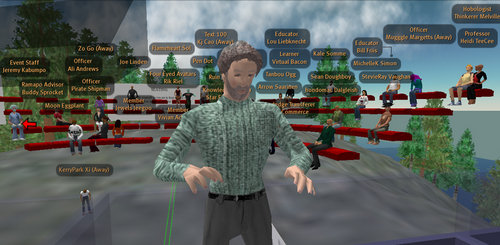
Dreams Community Fair 2007 had started!
posted by Namro Orman on Dreams using a blogHUD : [permalink]
Tags:


“In this episode of Who’s On Second? I talk with Stacy Stone (Goodwillstacy Stindberg). Stacy lives with Stacy’s transformation into a Second Life healthcare advocate began when she was 12 and was bitten in the face by a dog. The jaw injury that resulted in facial pain and a series of operations that left her with titanium jaw joints and a powerful desire to be an informed health consumer. Stacy is now a 25-year-old self-taught online marketing expert, writer and entrepreneur. She’s brought that expertise into Second Life on HealthInfo Island where she wants to make it easier for other patient advocate groups to nurture their niches in the 3D space. Hope you enjoy the show”
You can listen to this episode of Who’s On Second? here:
http://www.rabble.ca/rpn/files
or visit the show’s homepage at
http://rabble.ca/rpn/wos
please subscribe at:
http://www.rabble.ca/rpn/wos
And, please, check out my new podcast on Web 2.0 - Online Tools for the 21st Century at
http://rabble.ca/rpn/ott
There’ll be a new show every Thursday.


technorati tags: healthinfo island


The Alliance Library System (ALS) is pleased to announce that the National Library of Medicine/Greater Midwest Region has awarded ALS a $40,000 grant to provide consumer health information services in the virtual world of Second Life. ALS is working on the project in partnership with the University of Illinois Library of the Health Sciences-Peoria, Central Medical Library, Unversity Medical Center Groningen (UMCG) in the Netherlands,. and TAP Information Services.
“Providing Consumer Health Outreach and Library Programs to Virtual World Residents in Second Life” will allow the Alliance Second Life Library to provide training programs, outreach to virtual medical communities, important consumer health resources, and one-on-one support to Second Life residents.
Second Life (http://www.secondlife.com) is a booming virtual world with over 1 million residents.
“We are thrilled to receive this grant as it builds on efforts we have already started in Second Life to provide library services,” stated Kitty Pope, Executive Director of the Alliance Library System.
“This will allow us to provide important information in a virtual world whose citizens may not come or may not be able to reach a traditional library. For instance there is a group for stroke victims. In real life they may be physically limited. In Second Life, they can fly and be whomever or whatever they choose to be. There are no limits.”
“People are often seeking health information at stressful times in their lives, such as when they are facing diagnosis and treatment decisions,” said Jo Dorsch, Director of the UIC Library of the Health Sciences-Peoria. “By providing reliable information to people at the point-of-need we hope that consumers will make better informed decisions that will affect their health care and quality of life.”
Carol Perryman, a doctoral student in Library and Information Science with a specialty in medical librarianship at Chapel Hill, North Carolina, will serve as Project Coordinator. “ Librarians interested in exploring new ways to meet the needs of users cannot fail to be intrigued and rewarded by the potential of Second Life,” said Carol Perryman.
“On the other side of the avatar’s screen very real people have very real health information needs – and the grant project will provide real help to these consumers. I am pleased to be working with Aliance and other partners on this pioneering effort.”
Perryman will team with Guus van den Brekel, who has developed a clinical medical library in Second Life to develop services. Lori Bell from ALS, Jo Dorsch, Peg Burnette and Sandy DeGroote from UIC-LHSP, and Tom Peters from TAP information Services will participate as part of the project team. The group will work with established support groups in Second Life and reach out to new patrons who have health information needs.
This project has been funded in whole or in part with federal funds from the National Library of Medicine, National Institutes of Health, under Contract NO1-LM-6-3503.
Carolina and I (and all others participating) would like to welcome you on this event!
Come and have a look! And if you can not make it, comment on this blog, email or IM us and we will make an appointment to do a personal Tour later.
Self-Guided Tour
If you want to do a tour all by yourself: in the SL Medical and Consumer Health Library you can get a Tour Guide. It is a so-called Heads-Up Display and contains of a pre-defined chat-session.
You first get a copy of the Tour Guide Tool and from within your Inventory you choose WEAR. A blue button will appear in the Left-Top screen. Click on it and read the chat lines! You can that way walk the complete tour in the SLML ánd CHIL.

One of the Second Life Medical Library missions is to identify and list all relevant activities on the following subjects:
We can make any feed visible in your place.
As the RSS-reader in SL can only accept real RSS-format, I use www.feedburner.com to convert these feeds.
How about that for tailor-made services?
Who wants to see how it works on this blog?
 Have you ever been talking with someone whose normal speaking voice is too loud or too quiet, and had the overwhelming urge to simply adjust the volume controls? Or wished you could back up to a previous webpage – and there is no ‘back’ because, well, you’re not online, but in p2p mundane workaday time-locked rl? Oh – and then there’s the perplexity of the divide and merge of rl and (not) rl worlds and activities – how about you?
 I’d like to amend my appearance, and it annoys me intensely that there’s no pie chart. No skin color change, no way to perk up aging parts or change hair color without also dyeing several towels in the process. I find that my thoughts and actions in SL (as in a previous asynchronous community, but less so) are influencing my rl thoughts and actions. “Hang on a sec,” I want to say sometimes – “I was just talking about this last night with an educator in … Indiana.” Or from India, Germany, the Netherlands. And I was. We’re all increasingly global (so ‘they’ say, despite ongoing provincialism in libraries and other settings) but doing library stuff in SL is more so – mandated to be so, whatever our intentions. It must change our perceptions and practices back in rl.
Even if there is no back button.
be well, in all your worlds.



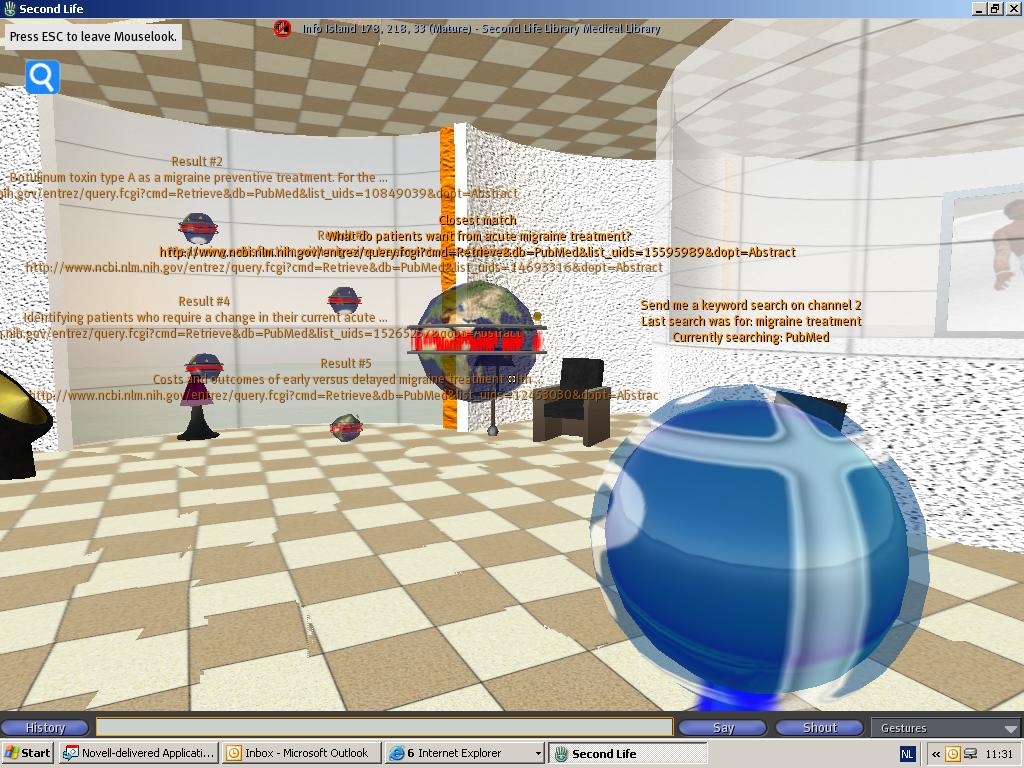 In-Life Search options in Second Life are still pretty limited. But we now have a few examples available as fully working display in the SLML!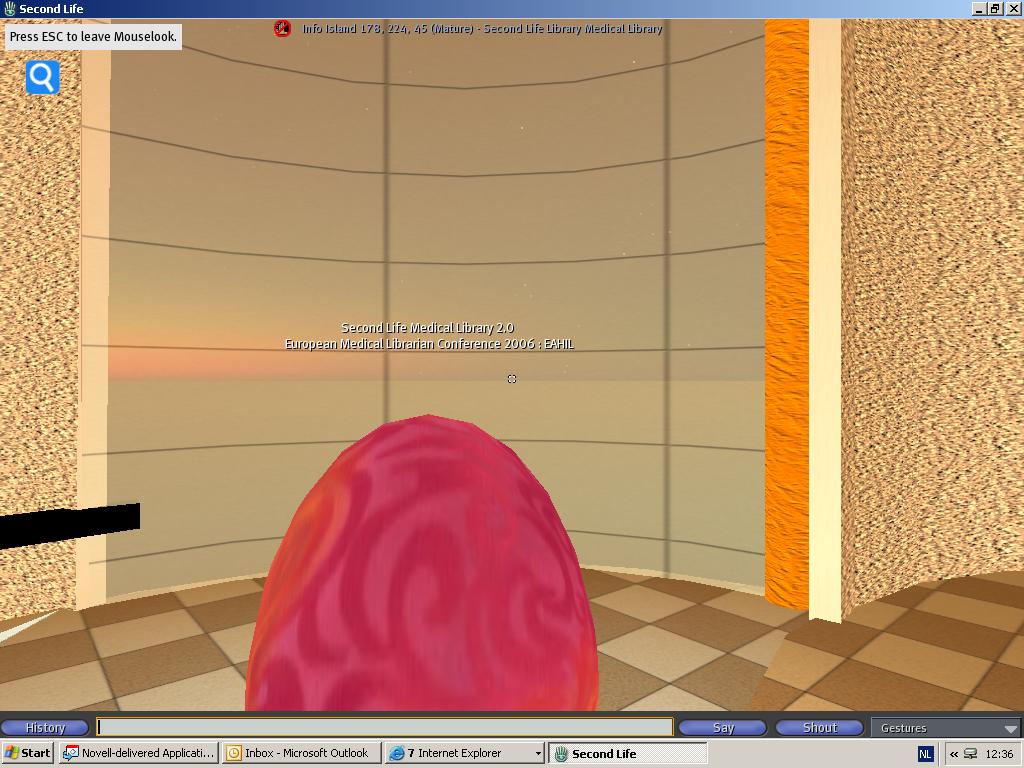




Categories: Ergonomics, SLML
 if it walks like a duck...
These and other criteria are things you need to be aware of when looking for health information (and any other info) online. What a lot of people don't realize is that any one of us could steal a logo (oh, like the AMA!) - and set up a website in very short order... fill it full of outdated and dangerous information... charge for some pamphlet... there is nothing much to prevent a 'fly-by-night' operation.
Categories: Quality-Health-Information
Feel free to ask for assistance at the Second Life Medical Library in evaluating health claims and sites. It’s why we’re here!

This is not by any means an exhaustive listing of all the reliable sites and resources. For more information – ask us! It’s why we’re here.


Plans for the Second Life Medical Library are well under way! After getting our gorgeous new building, we are busy dreaming and visualizing and connecting with others who are equally excited about the potential for a medical library at SL.
What has evolved, initially, is a 2-track focus on medical research and consumer health. For medical research, we are very pleased to say that PubMed will soon be searchable in-world in a manner similar to the OCLC search interface - but better! Searchers will be able to view the top nine citations, and we hope that the results and individual citations (including abstracts) can be copied to notecards. This is obviously beta, and will have limitations (especially with regard to just-in-time teaching), but it is a big step forward.
Be on the look-out for a display in the medical research area concerning the work of Moriz Gupte, who is conducting an NIH-funded simulation training project for bioterrorism preparedness. A real step forward from desktop simulation models, this project will offer medical and allied health personnel the opportunity to deploy staff and resources in the event of manmade and natural disasters.
We are hoping very much to have the medical research section function as a repository for information about medically related research taking place at SL and other virtual communities - it's a big question in my mind just how this might happen, given the decentralized nature of the beast, but we think it would be a good feature for practitioners and students. Moriz's documentation will be the first piece of what we hope will be a valued collection.
For consumer health, we will be offering links and info to a number of free sites, as well as educational assistance. There are lots of things 'out there' to help - so we will serve as guides to that universe of often bewildering (and frequently misleading) information. Those needing further or more specific assistence will be directed to their local library systems. Plans include a medicinal herb garden with links to research about uses, warnings, and effects (mostly Herbmed.com, a terrific site, and Medlineplus, which has really stepped up its coverage of complementary & alternative meds in the past few years).
Notecards on specific topics will be available (and I would very much like to figure out if the notecard could be more of a PDF because that way we can brand the docs), such as smoking cessation, herbs for specific uses, evaluating health information, and assistive devices. By far, however, efforts will be focused on outreach to SL's medical support communities. The big question is: what is needed and wanted? I guess that's why we're here, eh?
be well - Carolina Keats


